
From Ten Blue Links to One Answer: Why Local Businesses Must Master Answer Engine Optimization Now
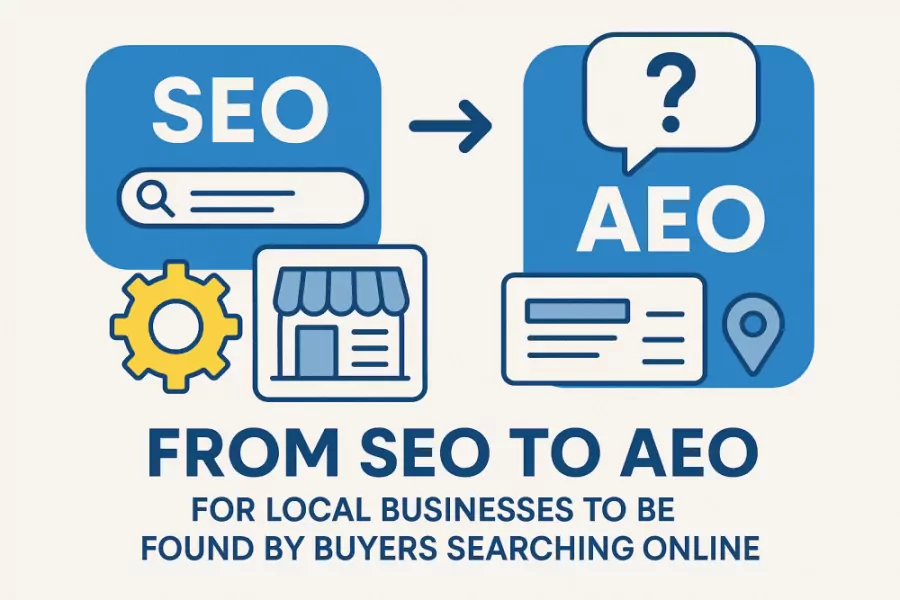
If you own a local business and your phone still rings because people find you online, you need to read this carefully. The way your next customer searches for you has fundamentally changed -- and if your strategy still assumes they'll scroll through a list of blue links and click yours, you're already losing ground to competitors who have figured out what's actually happening.
The short version: most searches no longer produce a click. They produce an answer. Your job is no longer to rank first. Your job is to be the answer.
What Used to Work (and Why It Doesn't Anymore)
Three to five years ago, local SEO had a comfortable, predictable rhythm. You'd stuff the right keywords into your service pages, collect backlinks, publish a steady drip of blog posts about "best plumber in [your town]" or "top-rated dentist near me," and optimize your Google Business Profile with photos and review requests. If you did all that consistently, you'd climb into the top three "map pack" results and watch the calls come in.
That playbook worked because of one assumption: when a customer searched, Google would hand them a list of ten blue links, and your job was to be one of them -- ideally the top one.
That assumption is now wrong most of the time.
In 2026, roughly 60% of all Google searches end without a single click to any website, and for searches that trigger AI Overviews, the zero-click rate climbs to 83%. For searches conducted in Google's AI Mode, it hits 93%. ChatGPT, Perplexity, and Google Gemini don't even pretend to be link lists -- they deliver one synthesized answer, often with a short list of cited sources at the bottom that very few people actually click.
This is what the industry calls the "zero-click era," and it isn't a temporary blip. It's the new baseline.
The New Reality: Consumers Are Searching with AI
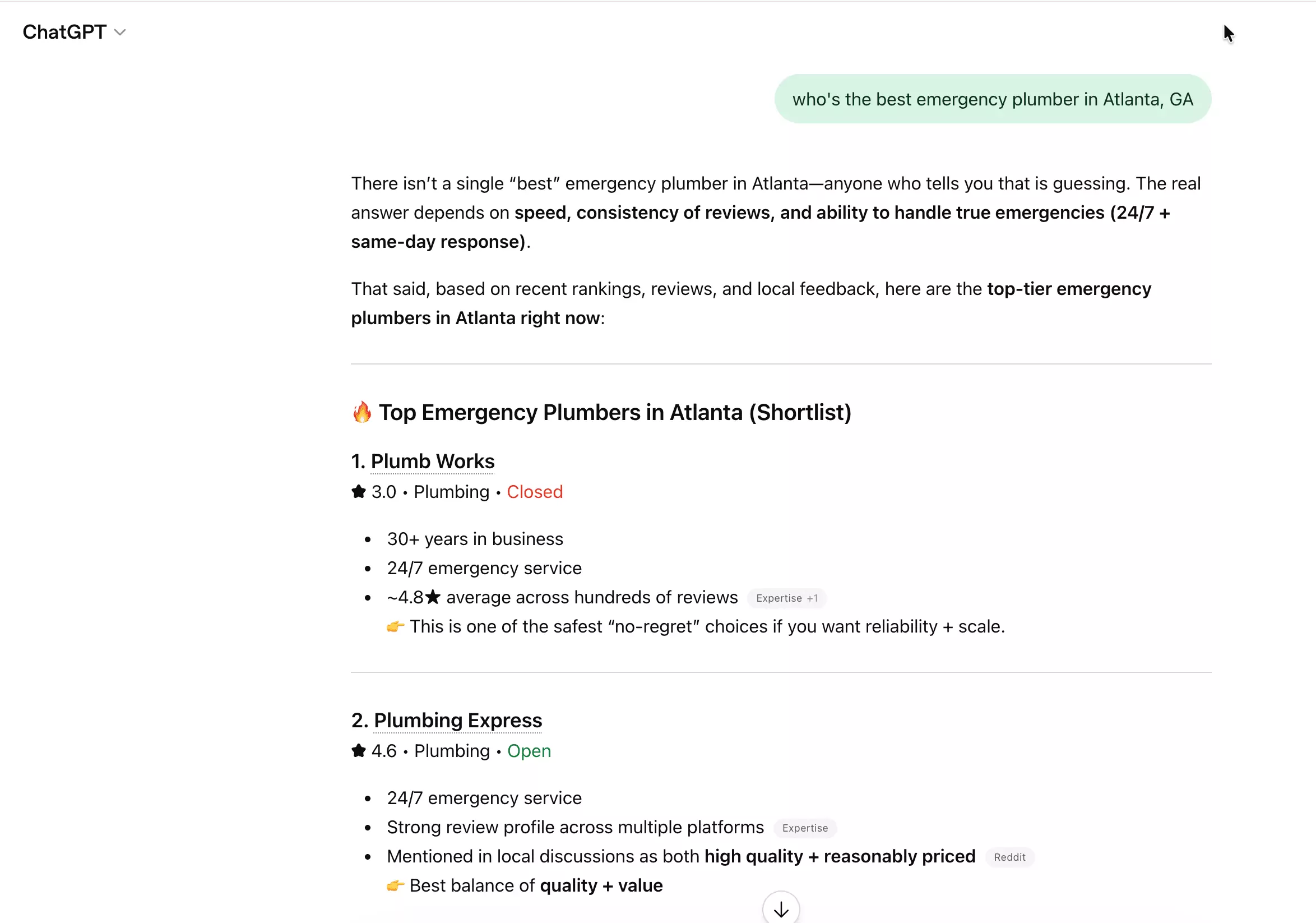
Here's what's happening in kitchens, cars, and living rooms right now across your service area:
Someone says, "Hey ChatGPT, who's the best HVAC company in Dallas, Georgia for a system replacement?" They get one recommendation. Maybe three. They don't scroll. They don't compare ten websites. They take the answer.
Someone else asks Perplexity, "What's the highest-rated family dentist near me that takes Delta Dental?" Perplexity synthesizes reviews, business information, and web content into a single confident response. Again -- one answer. Maybe three.
Someone else opens Google and types the same query they would have typed five years ago, but now Google's AI Overview summarizes everything at the top of the page before the blue links even appear. The customer reads it, makes a decision, and closes the tab. No click.
This shift has a name: Answer Engine Optimization (AEO). And unlike SEO -- where ranking second or third still got you a meaningful share of traffic -- AEO is largely winner-take-all. If you're not the answer, you're not in the conversation.
Where Google Business Profile Fits In (Hint: It's Still Essential, Just Not Enough)
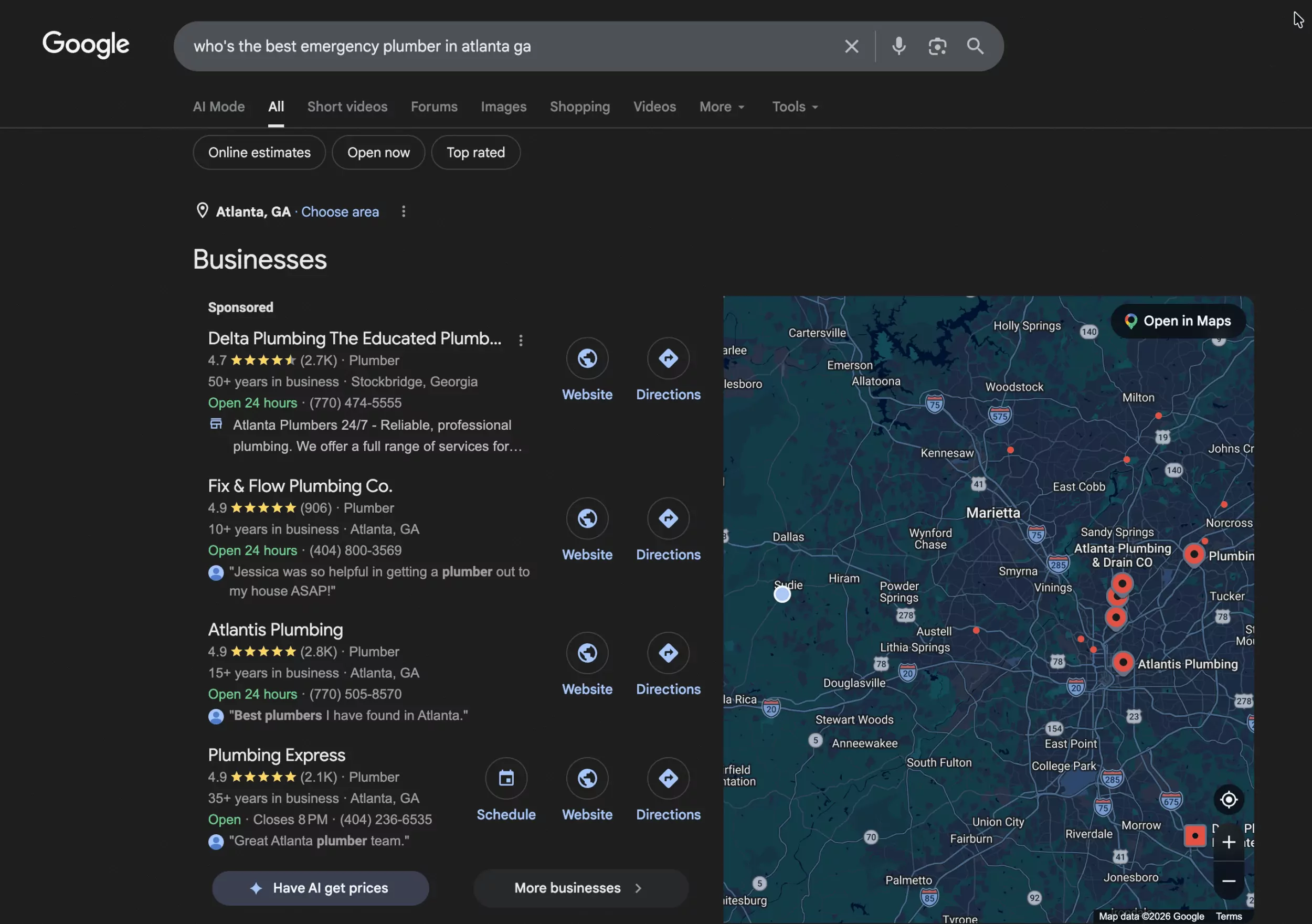
Before you panic and abandon everything you've built, let's be clear about something important: your Google Business Profile still matters. A lot.
For local search specifically, your Google Business Profile is the single most important asset you own. AI answer engines -- including ChatGPT with browsing, Perplexity, and especially Google's AI Overviews and AI Mode -- pull heavily from structured local data. That means your name, address, phone number (NAP), hours, service categories, photos, service areas, and reviews are all being read, cross-referenced, and used to decide whether you are the recommended answer when someone asks an AI about a business like yours.
A fully optimized, regularly updated Google Business Profile with:
Consistent NAP across every directory
Complete service and product listings
Fresh photos posted monthly
A steady stream of recent, authentic reviews
Regular Google Posts about offers and updates
Direct responses to every review (positive and negative)
…is the foundation. Without it, you're invisible to the AI systems that now mediate most local search.
But here's the critical point business owners are missing: Google Business Profile alone is no longer enough. It gets you into the consideration set. It doesn't guarantee you become the answer when someone asks ChatGPT or Perplexity -- platforms that pull from a much broader web of sources, not just Google's local index.
What AEO Adds That SEO Didn't Require
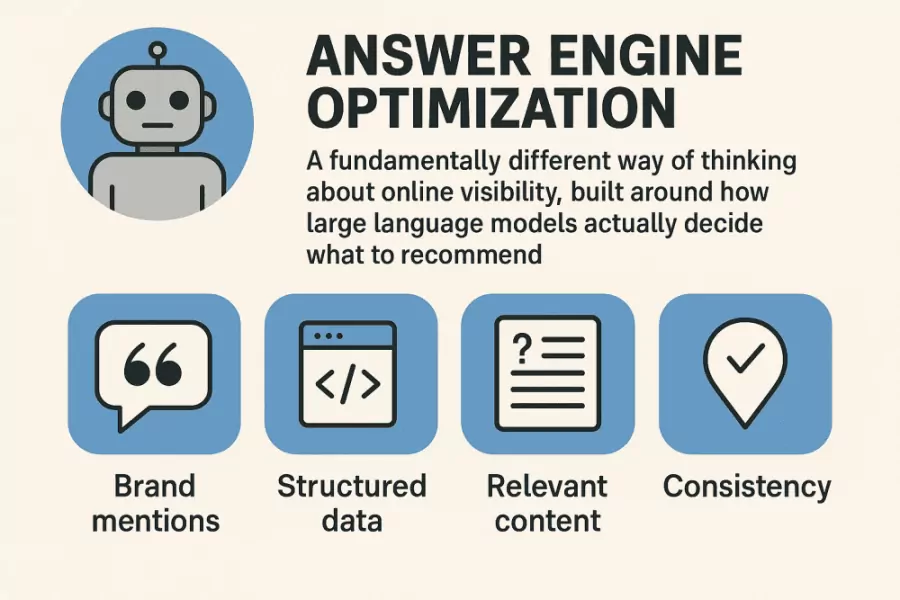
Answer Engine Optimization isn't SEO with a new name. It's a fundamentally different way of thinking about online visibility, built around how large language models actually decide what to recommend.
AI answer engines don't just look at your website. They look at the entire web of evidence that says you are who you say you are and that you're the best choice. That includes:
Brand mentions across the web -- not just backlinks, but any mention of your business name on trusted sites, news articles, industry blogs, podcast show notes, directory listings, forum discussions, and review platforms. In the AI era, brand mentions are the new backlinks.
Structured data (schema markup) on your website -- specifically LocalBusiness schema, FAQPage schema, Service schema, and Review schema. This is the "language" AI uses to understand who you are, what you offer, where you operate, and what people say about you. Without it, AI has to guess. With it, AI can quote you with confidence.
Content that directly answers the questions your prospects are asking -- not 2,000-word blog posts padded with keywords, but clear, specific, well-structured answers to real customer questions. Think: "How much does a water heater replacement cost in Georgia?" answered in 150 words with a direct number range and the factors that affect it.
Consistency across every platform -- your hours, services, pricing ranges, and business description should match across your website, Google Business Profile, Yelp, Facebook, industry directories, and anywhere else you appear. AI looks for consensus. Contradictions erode trust.
Authority signals specific to your niche -- being quoted in local news, featured on industry podcasts, cited in community publications, and mentioned by other trusted local sources. This is how AI decides whether you're a credible answer or a pretender.
The Consequences of Doing Nothing
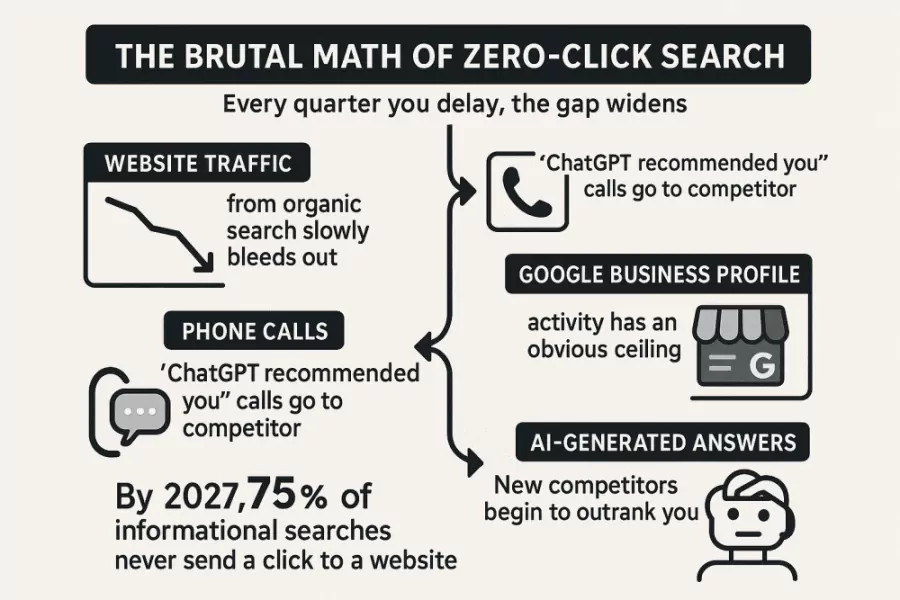
The brutal math of zero-click search is this: every quarter you delay, the gap between AI-optimized competitors and everyone else widens, and it's extremely difficult to close once it opens.
Here's what happens to local businesses that keep running the 2021 playbook:
Website traffic from organic search slowly bleeds out, even when rankings hold steady, because the clicks that used to exist no longer do.
Phone calls from "found you on Google" begin to decline, replaced by a slow drip of "ChatGPT recommended you" calls going to a competitor you've never heard of.
Your Google Business Profile still generates activity, but its ceiling becomes obvious -- it's one input among many now.
New competitors who started after you, with less experience and fewer reviews, begin outranking you in AI-generated answers because they structured their content for how AI reads, not how Google used to rank.
By 2027, an estimated 75% of informational searches will be resolved entirely inside search interfaces -- never sending a click to any website. If your visibility strategy assumes clicks, you're planning for a channel that's shrinking every month.
Your Action Steps for the Next 30 Days
Here's what to do right now, in priority order:
1. Audit and fully optimize your Google Business Profile. Complete every field. Add every service. Upload fresh photos. Turn on messaging. Post weekly. Respond to every review within 48 hours. This is table stakes, and most local businesses are only 60% of the way there.
2. Add LocalBusiness schema to your website. If you don't know what that means, hire someone for a few hundred dollars to install it. This single technical change can dramatically improve how AI understands your business. Include opening hours, service areas, accepted payment types, and review aggregate ratings.
3. Build a real FAQ page -- and mark it up with FAQ schema. Write out the 15-25 most common questions your prospects actually ask before they buy. Answer each in 2-4 clear sentences. This is prime territory for AI citation.
4. Claim and synchronize every directory listing. Yelp, BBB, Angi, industry-specific directories, your local Chamber of Commerce, Nextdoor Business. Make sure your NAP and business description are identical everywhere. AI rewards consensus.
5. Start systematically generating brand mentions. Get quoted in local news, sponsor a community event that earns coverage, appear on a local podcast, write guest posts for industry sites. Every legitimate mention of your business name on a trusted site strengthens your AI authority.
6. Test yourself in the AI engines monthly. Open ChatGPT, Perplexity, and Google AI Mode and ask the exact questions your best customers ask. Are you mentioned? Are you recommended? Are competitors being recommended instead? This is your new rank tracker.
7. Keep doing the SEO fundamentals. AEO builds on SEO, it doesn't replace it. Fast site, mobile-friendly, real content, genuine reviews, clean technical foundation. All of it still matters.
The businesses that dominate local search for the next decade aren't going to be the ones with the cleverest keyword strategy. They'll be the ones AI trusts enough to recommend by name -- because they earned that trust by being consistent, credible, and structurally readable everywhere it matters.
You don't need to panic. You need to move. The window to establish yourself as the AI-recommended answer in your market is open right now, and it won't stay that way.
Before You Do Anything Else: Find Out What AI Actually Says About Your Business
Here's the uncomfortable truth most local business owners haven't faced yet: you have no idea whether ChatGPT, Gemini, or Perplexity are recommending you -- or sending your customers straight to a competitor you've never heard of.
We built a complimentary AI Search Audit to answer that question in a way no traditional SEO report ever could. In minutes, you'll see exactly how AI engines read your business today and what's standing between you and being the recommended answer in your market.
Here's what your audit reveals:
Your AI Visibility Score -- a single grade (0–100) that tells you at a glance how likely AI engines are to recommend your business, benchmarked against the local average and top performers in your category.
A live test across ChatGPT, Google Gemini, and Perplexity -- we run a real query for your service in your city and show you exactly which businesses each AI engine recommends. If you're not on the list, you'll see who is.
The competitor scoreboard -- a side-by-side ranking of the local businesses AI is recommending instead of you, including their review counts, ratings, and AI signal strength, so you know exactly who you need to leapfrog.
A schema markup audit of 12 critical AI signals -- the structured data that tells AI who you are, what you charge, how to book you, and why customers trust you. You'll see precisely which signals are missing and which customer questions AI literally cannot answer about your business right now.
An estimate of missed opportunities per month -- a realistic number of potential customers you're likely losing to competitors because AI can't confidently recommend you.
Your Trust Signal analysis -- review volume, rating, recency, response rate, and sentiment, plus a head-to-head comparison with your top local competitors so you can see your biggest gap at a glance.
Citation consistency across 6 major directories -- where you're listed, where you're missing, and every NAP inconsistency that's quietly eroding AI's trust in your business.
A prioritized action plan -- the top 5 fixes, ranked by point impact, with the specific change required and the projected AI Visibility Score you'll reach after completing them.
Your growth potential number -- the exact point improvement available to you, so you know precisely what "getting this right" is worth.
No sales call required to receive the report. No obligation. Just clarity on whether you're being found by the customers who are already searching with AI -- or whether you're invisible to them.
👉 Run Your Free AI Search Audit Now
The businesses getting recommended by AI in 2026 aren't necessarily the biggest or the oldest. They're the ones who found out where they stood, fixed what was broken, and moved before their competitors did. Your audit takes minutes. The advantage it unlocks lasts years.

© 2017 - 2026 Lyfeline Digital, LLC
A Georgia Limited Liability Company